- Moonshot Minute
- Posts
- Why Lockheed's Biggest Threat Isn't China
Why Lockheed's Biggest Threat Isn't China
Defense budgets surging 3.4x. Here's where the money is flowing

Donald Doge
April 22, 2026
In the opening hours of the U.S.-Iran conflict this March, a swarm of Iranian drones, each costing between $20,000 and $50,000, destroyed billions of dollars worth of American radar installations across the Middle East in a single afternoon.
Replacing that hardware will take years.
The U.S. fired Patriot interceptors at incoming Shahed-136 drones. Each Patriot missile costs between $2 million and $4 million. The Shahed-136 drones that were shot down cost roughly $30,000 apiece to produce.
Russia, which derives its Geran drone from the Shahed design, produces over 400 units per day. Iran's own capacity exceeds 10,000 per month.
The arithmetic is remarkable. A single Shahed costs the attacker roughly one percent of what it takes to shoot one down.
Multiply that by thousands of drones per month, and you see why the global defense industry is racing to rewrite its cost structure.
I'm not a military strategist. I grew up in a lower-middle-class household, taught myself to read markets, and built wealth by spotting structural shifts before the crowd catches on.
What I see unfolding in global defense right now is one of the most important structural shifts of our lifetime.
Set politics aside. What's underneath those headlines is a fundamental change in how wars are fought and where defense capital flows next.
$5.6 Billion in Two Days
During the first 48 hours of the U.S.-Iran conflict, America expended $5.6 billion worth of munitions. That's roughly the GDP of Bermuda, fired into the sky before most Americans finished their morning coffee on day three.
The Pentagon isn't waiting around. It's already building its next-generation doctrine around exactly this math. It has a name: "Affordable Mass."
Ten Drones for the Price of One Missile
The new logic is simple. Whoever builds the most effective weapon at the lowest cost, at the highest possible volume, wins the next war.
The Pentagon sees this clearly, and the capital allocation is already moving to back it up.
A Tomahawk cruise missile costs roughly $2 million. The LUCAS drone, a reverse-engineered copy of Iran's Shahed-136 built by an Arizona startup called SpektreWorks, costs $35,000 to $40,000. That's 1.7% of a Tomahawk's cost.
You can launch ten LUCAS drones at a single target and still come out cheaper than firing one legacy missile.
On the defensive side, the mismatch turns absurd. Japan recently scrambled two F-15 fighter jets, at $32,000 per jet per scramble, to intercept Chinese unmanned aircraft operating at roughly $450 an hour.
That's like hiring a private security detail to chase a mosquito.
Ukraine's "Sting" interceptor drone physically collides with enemy drones at $2,100 to $2,500 per unit. Israel's Iron Beam laser system takes out a drone for $2 to $5 per shot. Epirus' Leonidas high-powered microwave system disrupts drone electronics for pennies per kill.
This is the new economics of war, and the capital allocations are being rewritten around it.
The U.S. Air Force is accelerating multiple "affordable mass" programs, including ERAM, FAMM, Black Arrow, and Barracuda-500, all designed to produce low-cost, scalable, rapidly deployable munitions.
The Pentagon's Drone Dominance Program plans to invest $1.1 billion purchasing thousands of drones by 2027.
Japan allocated $640 million for SHIELD, a layered coastal defense system built on expendable drones and loitering munitions.
Europe's defense spending is projected to surge 3.4 times over the next six years, with capital flowing to companies like Destinus and Helsing.
The tidal wave of money is already in motion.
Where the Asymmetric Returns Live
The biggest gains come from spotting structural shifts before the crowd shows up.
When I first started writing about gold and critical minerals, people thought I was out of my mind. When I pounded the table on rare earths and the China supply chain chokepoint, the mainstream financial media was still obsessing over AI chatbots.
The investors who positioned early in those themes are now outperforming the S&P 500 by more than three or four times.
The defense-tech shift toward affordable mass is the same kind of structural break.
Companies like Lockheed and Raytheon built their empires on cost-plus contracts and decades-long procurement cycles. That model is being reinvented from the inside.
A recent McKinsey analysis declared the end of the "walled garden" era, where a single prime contractor controlled the entire vertical. Militaries now demand open architectures, modular systems, and software-hardware separation that allows continuous updates without rebuilding the physical machine.
The Pentagon is reforming its procurement process to "startup speed."
Capital is migrating from the legacy primes to a new breed of smaller, faster, more innovative companies that can build, iterate, and deploy at a pace the old guard can't match. That's where the asymmetric returns live.
What's on My Desk
Everything up to this point is the thesis. It's enough to start repositioning your portfolio yourself if you want to do the deeper homework. Premium members pay me to do that work for them.
My team and I have been deep in the research on a basket of companies sitting at the critical nodes of this shift.
The explosive growth is one layer deeper than the legacy primes: in the companies supplying the low-cost munitions, counter-drone systems, sensor stacks, and the connectivity infrastructure that makes the whole swarm actually work.
I'm pressure-testing a short list of names with my lead analyst right now. Some are pure plays on affordable mass. Some are pick-and-shovel plays on the infrastructure every drone needs to fly a mission.
Whatever makes the cut will have a defined catalyst, a clear thesis, and a downside we've modeled.
We're not done yet. Earnings season is live and the noise-to-signal ratio is high. The worst thing I could do for Moonshot Minute Premium members is push an alert ahead of a binary event when waiting a week gives us a cleaner setup at a better price.
Not losing money matters as much as making it.
Next week, my defense-tech coverage goes out to Premium members. Entry guidance, position sizing, catalyst calendars, and downside scenarios.
Everything my members expect when I put a name in front of them.
If you're on the free list, you'll get a recap of the theme. Premium members get the names, the entries, and the follow-on coverage as the positions develop.
The Price Is Going Up
Moonshot Minute Premium is going up in price.
New members joining after the change will pay more. Anyone already subscribed at today's rate will be grandfathered in as long as they stay active.
I'll announce the exact date in next week's issue, alongside the defense-tech coverage.
If you've been on the fence about upgrading, the window to lock in today's price is narrowing.
Year one of Moonshot Minute Premium, by the numbers:
Every closed trade has been profitable. Nine trades, zero losses.
Average closed-trade gain of roughly 68%.
Six positions that doubled, with half the stake sold to recover the original capital and the rest riding at a zero-cost basis. Every future dollar on those positions is pure profit for our members.
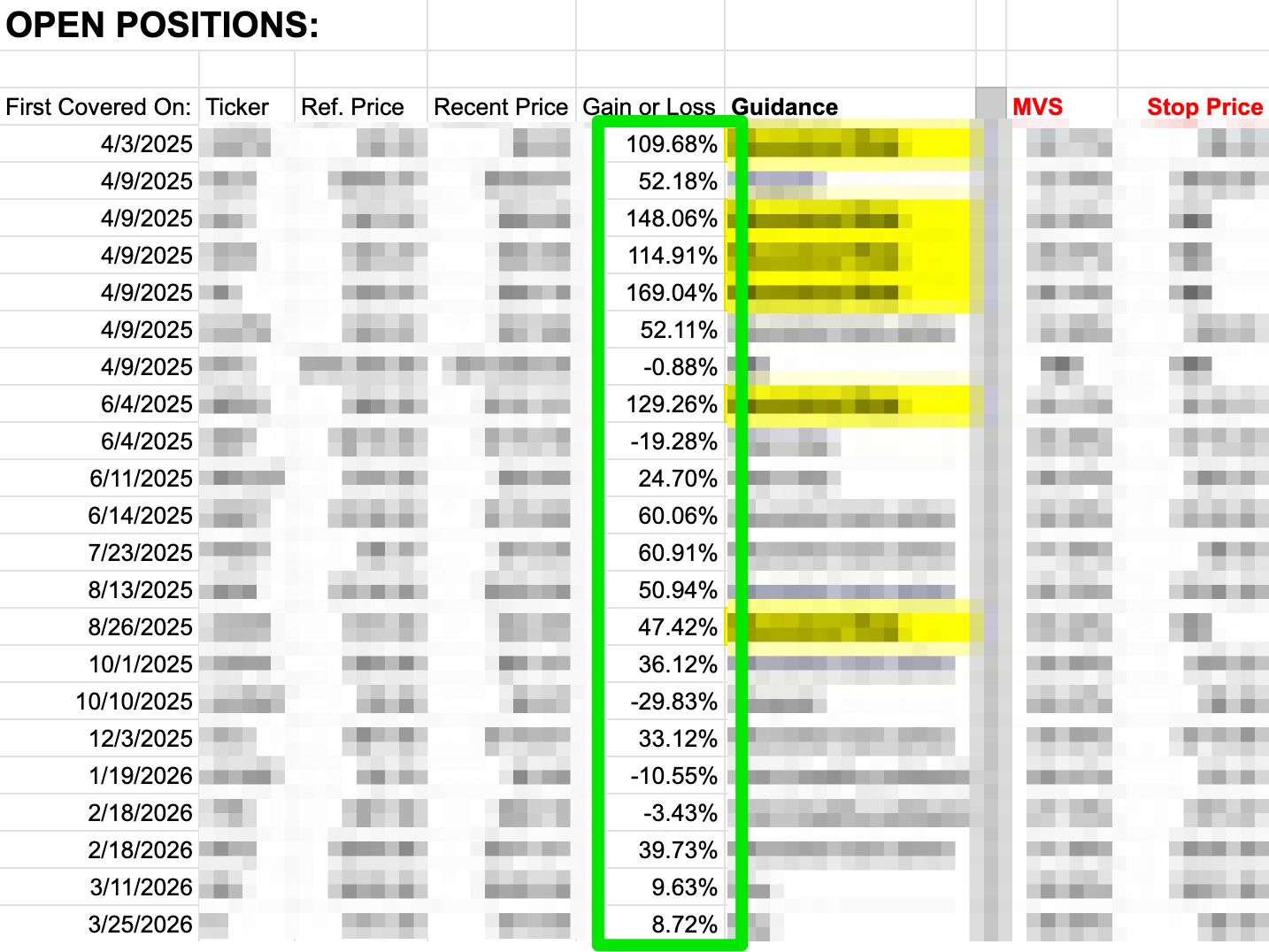
Five currently open positions are up triple digits.
Those numbers are a byproduct of the same discipline that's framing next week's coverage. Thesis first, catalyst second, downside modeled, capital preserved as aggressively as it's deployed.
The world's militaries are rewriting the rules of warfare in real time. American defense capital is leading the repositioning.
The only question is whether you position yourself before the crowd arrives or after.
I know which side of that trade I want to be on.
Double D
P.S. Here’s a screenshot of the current Moonshot Minute Portfolio. I’ve blurred out the tickers since that information is only for Premium Members, but you can see how we’ve done so far:
🔓 Premium Content Begins Here 🔒
In today's Premium Section, an update on our AI data center buildout positions and how we’re playing multiple triple and double-digit winners, as well as updated guidance and a buy for a ticker we believe is set to outperform over the next 12 months.
I hope you’ve been paying attention because many of our picks are currently beating the S&P by up to 4-to-1 over the last 12 months.
Most financial newsletters charge $500, $1,000, even $5,000 per year. Why? Because they know they can.
I don’t.
I built my wealth the old-fashioned way, not by selling subscriptions.
That’s why I priced this at $25/month, or $250/year.
Not because it’s low quality, but because I don’t need to charge the typical prices other newsletters charge.
One good trade, idea, or concept could pay for your next decade of subscriptions.
The question isn’t ‘Why is this so cheap?’ The question is, ‘Why would I charge more?’
P.S. If this newsletter were $1,000 per year, you’d have to think about it.
You’d weigh your options. You’d analyze the risk.
But it’s $25 a month.
That’s the price of a bad lunch decision.
And remember, just one good idea could pay for your subscription for a decade.
Recent comments from Premium Members:
Amazing! Moonshot is hands down the best $150 decision I have ever made. Up 64% on TICKER REDACTED (so far). Can't thank you enough for your service, advice, recommendations, insight, and every other positive accolade in the dictionary.
Very respectfully and gratefully,
CK
I’m up 71% in 6 weeks would you recommend adding to this bucket if capital allows?
MS
Hello Double D,
As it happened, I already owned some TICKER REDACTED shares when you recommended the stock. Upon your recommendation, I bought more. All told, I'm up over 70% in a month or two.
I greatly appreciate the detailed discussion you and your team provide for your recommendations.
Thank you.
A happy subscriber,
PK
I finally got some liquidity I could use and bought the stock as well as March 2026 calls yesterday morning (October 2nd) when it was at $17.80.
That is easily the best-timed investment/trade I've ever made, and I have your team's perpetual hard work and research to thank for it.
Thanks again for all the hard work. You and your team push out a lot of solid research, and the effort doesn't go unnoticed.
It is greatly appreciated,
MD
Closing at 24% gain, and enough profits to pay for 2yrs of your newsletter. Thank you for this! I especially appreciate you detailing the rationale behind your picks. As a newer investor it’s important for me to know why just as much as what.
MS
Up 68.87% on TICKER REDACTED to date, great recommendation!
BW
Thanks for the great tip on TICKER REDACTED! I bought, and just eight trading days later, it's up 52% as of this very minute. I'm new to your newsletter, less than two months, but I have found it to be quite soundly researched and a truly invaluable source.
I've been actively investing for many years and have, at one time or another, subscribed to various investment advisors. None have been as useful (nor as affordable!) as the Moonshot Minute.
You, sir, do excellent work and we individual investors much appreciate it.
SD
Up 66%! Thanks.
SB
Kudos and thank you for the TICKER REDACTED recommendation. TICKER REDACTED has been awesome and I do understand/believe this to possibly be only the beginning. I bought 200 shares at $16 and another 100 at $18, the day before the surge started. Again, I am very grateful.
RH
I've only been with you a few weeks now, and overall, my portfolio is up 41%. Couldn't have done it without you, DD. Thanks again.
HJP
I joined your plan about 2 months ago.
TICKER REDACTED was a real hit - and I did fully realize it yesterday for a rise - 141%. Great deal!!
IS
Just wanted to drop you a quick THANK YOU! Been a member for about a week (I wanted to see your picks for the electrical asymmetry) and I picked up some TICKER REDACTED & TICKER REDACTED. I’m already up $1,300.00 so my membership is covered for 5 years in about a week!
Keep up the great work! Again, THANKS! Glad to be a subscriber!
RH